


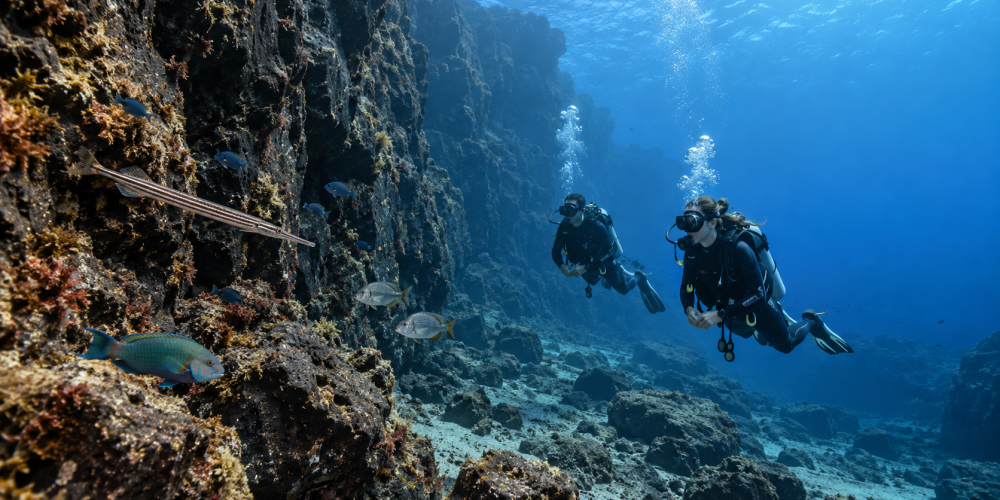
Palm-Mar Wall, also known as El Bufadero or Buffadero, was long regarded as one of the best-known dive sites in the south of Tenerife. Many divers associated the name primarily with large rays and turtles that could apparently be observed regularly and at close range. However, anyone visiting the site today with exactly these expectations may be disappointed. The dive site has changed, just like Aquarium and El Puertito.
This does not mean that Palm-Mar Wall has suddenly become a bad dive site. It does, however, mean that it should be viewed differently today: less as a supposedly reliable place for encountering large animals and more as a dive along a volcanic wall where the underwater landscape, smaller marine life and the conditions on the day take centre stage.
Palm-Mar Wall and El Bufadero: Two Names for the Same Dive Site
The dive site is located off the coast of Palm-Mar in the south of Tenerife and is normally reached by boat. Different names and spellings appear in dive-site descriptions: Palm-Mar Wall, Palmar Wall, El Bufadero and Buffadero. In general, they all refer to the same area along the volcanic coastline.
Underwater, the different routes cross rocky areas and continue along a descending wall. Cracks, small overhangs and irregular lava formations provide hiding places for moray eels, octopuses and other typical inhabitants of the rocky Canary Island coastline. Over the sandy areas or in open water, you may also encounter a ray or a larger fish if you are lucky.
The route that is actually followed depends on the group, the divers’ certification levels, the current, the swell and the position of the boat. Palm-Mar Wall cannot therefore be classified in general terms as either a particularly easy or a particularly difficult dive site. The depth and route must be appropriate for the divers’ experience and the conditions on that particular day.
Why This Dive Site Was Known for Rays and Turtles
Palm-Mar Wall’s former reputation was not based entirely on an exceptionally high natural concentration of large animals. For a long time, rays and turtles were fed there by divers or dive operators.
As a result, some of the animals became accustomed to people and boats. They approached groups of divers because they expected to receive food. This gave visitors the impression that encounters with rays and turtles at this dive site were almost a matter of course.
Similar developments occurred at other well-known sites in Tenerife. Aquarium was visited mainly because of its rays, while El Puertito was known for many years as a place offering particularly close encounters with turtles. There too, the animals becoming accustomed to people and food played an important role.
Although these encounters may have been impressive, they did not represent completely natural behaviour. A wild animal searching for food independently or passing a group of divers by chance behaves differently from an animal that associates divers with a source of food.
Why Feeding the Animals Is Not Harmless
Feeding marine animals is now prohibited and goes against the principles of responsible interaction with wild and protected species. The purpose is not to prevent divers from enjoying an interesting encounter. The rules are intended to protect the animals and their natural behaviour.
Regular feeding can have several consequences:
- The animals change their natural feeding behaviour.
- They begin to associate people and boats with food.
- They lose some of their natural distance from people.
- Unsuitable food can cause health problems.
- Individual animals may spend more time in a place that has been made artificially attractive.
- The behaviour and distribution of several species may be affected.
In the case of turtles, getting too close, touching them or crowding them as divers, snorkellers or swimmers can cause additional stress. The fact that an animal does not immediately swim away does not necessarily mean that the situation is harmless for it.
Responsible diving therefore means observing the animals, keeping your distance and allowing them to decide whether they want to approach or move away. They should never be chased, touched or attracted with food.
What Has Changed Since the Feeding Stopped
Since feeding the animals is no longer permitted, the former gatherings of large rays and the regular encounters with turtles have decreased considerably. According to Ocean Trek’s current observations, turtles and larger fish are now rarely seen at Palm-Mar Wall.
The situation is similar at Aquarium and El Puertito. Some older dive reports, videos, photographs and dive-site descriptions still present the image people remember from previous years. Anyone planning a diving holiday based on this information may therefore arrive with expectations that no longer reflect the current situation.
This change should not be taken as proof that the animals have completely disappeared from the surrounding waters. Marine animals move between different feeding, resting and living areas. Their distribution can change as a result of food availability, the season, water temperature, currents, boat traffic and many other factors.
Above all, this development demonstrates how strongly artificial feeding can influence the way a dive site is perceived. When the food is no longer provided, the animals redistribute themselves and once again follow their natural needs more closely. For divers, this reduces the likelihood of a close encounter. For the animals, however, returning to more natural behaviour is fundamentally positive.
Is Palm-Mar Wall Still Worth Diving?
The answer depends on what you expect from the dive. If your only objective is to see turtles and large rays at close range with a high degree of probability, Palm-Mar Wall is currently not the most convincing choice.
However, if you enjoy diving alongside volcanic rock formations, carefully examining cracks and overhangs and paying attention to smaller species, the site can still be interesting. Moray eels, octopuses, trumpetfish, parrotfish, sea bream and small schools of fish are typical inhabitants of Tenerife’s rocky underwater landscapes. Nevertheless, the species seen on any particular dive will always depend on the conditions and a certain amount of luck.
A good dive site is not defined solely by its largest animals. Divers who move slowly and look carefully often discover far more than those who spend the entire dive searching exclusively for a turtle. Even so, a dive centre should be honest when the current character of a site no longer matches older descriptions.
Where Are There Currently Better Chances of Seeing Turtles?
According to Ocean Trek’s current local observations, Abades presently offers better chances of a natural encounter with turtles. Abades is located on Tenerife’s south-eastern coast and has a sheltered bay with rocky reef areas, sandy sections and seagrass meadows.
It is precisely this combination of habitats that makes the site interesting. Turtles may move through the area in search of food, swim past the reefs or appear above the seagrass meadows. Nevertheless, a sighting cannot be arranged on demand.
There are a few dive sites where there is a good chance of seeing turtles. However, no one can honestly offer a guarantee. Even without a turtle, a dive in Abades can be very varied. Depending on the route and conditions, divers may encounter different reef fish, moray eels, octopuses, rays or, depending on the season, angel sharks.
Where Are Rays More Likely to Be Seen at the Moment?
Playa San Juan on Tenerife’s west coast is currently more interesting for rays. There is a small fishing jetty there. According to current observations, fish remains from fishing activities regularly enter the water in the surrounding area. Rays, and occasionally turtles, find food there and therefore spend time in this area.
There is no guarantee here either. Rays often lie well camouflaged on sandy bottoms, move across the seabed or change their location. Their presence can vary from one day to the next.
The area around a fishing jetty also requires particular attention. Boat movements, lines, harbour activity and local conditions must all be considered during the planning of the dive. The decision about whether diving is possible there and which route can be followed should therefore always be based on the current situation.
It is also important to distinguish between deliberately feeding animals to create an encounter and animals independently seeking out natural or already existing sources of food. In both cases, divers should not provide additional food, surround the animals or prevent them from having sufficient space.
Dive Sites Are Not Aquariums with Permanent Residents
The changes at Palm-Mar Wall clearly show why statements such as “You are guaranteed to see turtles there” are problematic. A dive site is not an aquarium in which certain animals live permanently within a defined space.
Turtles, rays and larger fish move freely. The fact that they used to appear regularly at a particular location may have been connected to artificial feeding, a temporarily attractive food source or other changing conditions. When these factors disappear, the likelihood of encountering the animals also changes.
The choice of a dive site should therefore not depend solely on one animal species that a diver hopes to see. The following factors are equally important:
- the divers’ certification levels and experience;
- an appropriate depth;
- the current and swell;
- the entry and exit or the conditions around the boat;
- the time that has passed since the last dive;
- the interests of the entire group;
- possible alternatives if the conditions are unsuitable.
For this reason, Ocean Trek does not choose a dive site solely on the basis of previous animal sightings or a well-known name. The deciding factors are the current conditions, the divers’ level of experience and a realistic assessment of what each site can offer at that particular time.
An Honest Look at Palm-Mar Wall
Palm-Mar Wall, or El Bufadero, remains a well-known dive site on Tenerife’s southern coast. However, its character has changed. The time when fed rays and turtles approached groups of divers almost automatically should not be used as a benchmark for dives today.
According to Ocean Trek’s observations, turtles and larger fish are currently seen there only rarely. Anyone looking for better chances of encountering turtles may consider Abades. Playa San Juan is currently particularly interesting for rays. Even at these sites, however, every encounter remains an unpredictable experience in nature.
This is precisely where the essential difference between responsible diving and an artificially staged wildlife encounter lies: we visit the animals’ habitat without changing their behaviour to meet our expectations. If a turtle then moves peacefully across the reef or a ray rises from the sand, the encounter may not be guaranteed, but it will be genuine.