


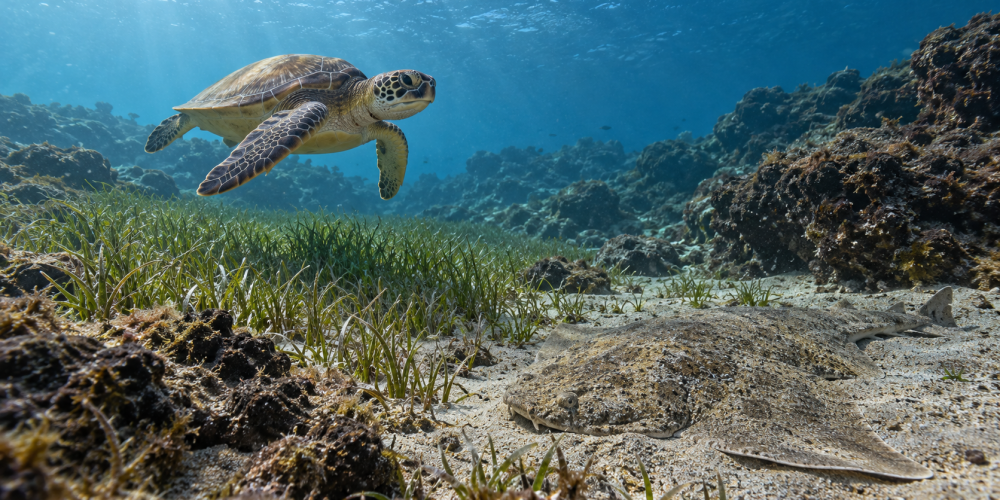
Are you looking for a dive site in Tenerife with easy access, varied reefs and good options for adapting the dive to different experience levels? If so, you will probably come across Abades. This sheltered bay on the southeast coast is considered an easily accessible site for beginners and divers returning to the water after a break.
That description is correct, but it does not tell the whole story. Abades is by no means just a training site. Different routes can be planned between sandy areas, seagrass meadows and several volcanic reefs. Experienced divers who move slowly and look closely can also enjoy a varied and interesting dive here.
How interesting the site becomes depends less on reaching the greatest possible depth and more on the chosen route, good buoyancy control, careful observation and the conditions on the day of the dive.
Where Is Abades?
Abades is located in the municipality of Arico on the southeast coast of Tenerife. The usual access point to the dive area is at Playa de Los Abriguitos. This 250-metre-long bay consists of fine, dark volcanic sand and is easily accessible on foot or by car. Parking, shops and restaurants can be found close to the beach.
Tenerife’s official tourism portal specifically describes Los Abriguitos as a popular diving area, citing its easy access to the water and the beauty of the seabed as the main reasons.
The curved shape of the bay often provides comparatively calm conditions. However, “often” does not mean “always”. Abades is still exposed to the open Atlantic. Wind, waves, currents and visibility can all change. Before every dive, we therefore check whether the entry point, planned route and return to shore are suitable for the particular group.
- Location: southeast coast of Tenerife, municipality of Arico
- Entry: from a dark sandy beach
- Type of dive: shore dive
- Seabed: sand, seagrass and volcanic reefs
- Typical depth range: approximately 6 to 20 metres, depending on the route
- Underwater landscape: gently sloping sandy seabed, rock formations, small overhangs and reef edges
- Suitable for: certified beginners, returning divers and experienced holiday divers
- Possible sightings: trumpetfish, moray eels, barracudas, rays, cuttlefish, schooling fish and, with a little luck, angel sharks or turtles
- Special feature: several possible routes within an extensive diving area
We describe Abades Bay as an extensive shore-diving site with several reefs at depths of approximately 6 to 20 metres. The Abades Mountain route is also located nearby. There, the seabed descends in stages to around 12 to 20 metres. This explains why different descriptions of the dive site are not necessarily contradictory: the name Abades covers several routes within the same coastal area (Ocean Trek: Abades Bay, Ocean Trek: Abades Mountain).
A Comfortable Entry from the Beach
One of the main advantages of Abades is its beach entry. Instead of having to climb over sharp rocks while wearing all your equipment, you can normally walk into the water across the sand.
The first few metres are shallow. This gives the group time to check their equipment, get organised and begin the descent in a controlled manner. Less experienced divers often find this more comfortable than entering directly into deep water.
Underwater, the route initially leads across sand and, in some places, over seagrass, where turtles can sometimes be found. Farther out, the volcanic reef structures begin. Depending on the chosen route, we can dive along reef edges, alternate between sandy and rocky areas or head towards deeper sections.
Because the seabed slopes gradually, the depth can be adapted to the participants’ training and experience. This makes Abades an interesting option for groups with different experience levels. A less experienced diver can follow a shallower route, while an experienced diver can explore more of the outer reef structures on a different route.
A Varied Underwater Landscape
Abades does not have one dramatic wall or a large wreck. Its appeal comes from the transition between different habitats.
Open sandy areas merge into dark volcanic rock. Between them are patches of seagrass, small crevices, overhangs and sheltered areas. In some places, the reefs run roughly parallel to the coastline. This allows different outward and return routes to be planned, so you do not have to repeat exactly the same dive on every visit.
The seagrass areas are particularly important. In the Canary Islands, a seagrass meadow of this kind is often referred to as a sebadal. In Abades, these areas consist of the seagrass species Cymodocea nodosa. This is a true seagrass, not an alga. It creates a habitat where juvenile fish and various invertebrates can find food and shelter.
Canarian seagrass meadows are sometimes incorrectly referred to collectively as Posidonia. That term is not appropriate for Abades. The scientific description of the Abades–El Porís area specifically identifies Cymodocea nodosa (Important Shark and Ray Areas).
Which Marine Animals Can You See in Abades?
Between the rocks, you can look for trumpetfish, moray eels, wrasses, seabream and small schooling fish. Barracudas may appear in open water. Rays can sometimes be seen over the sandy areas, while cuttlefish often stand out because of their camouflage—or, for precisely that reason, initially remain unnoticed.
Turtles are also observed in Abades, particularly in the shallower areas with seagrass. However, a sighting can never be promised. Turtles move freely, and even a suitable habitat does not guarantee that an animal will be present during a particular dive.
The same applies to angel sharks. These flat, shark-like bottom dwellers often lie partly buried in the sand and are exceptionally well camouflaged. Divers who swim quickly over the seabed may overlook an animal even if it is only a few metres away.
Keeping your distance is essential when observing an angel shark. It must not be touched, uncovered, followed or startled for the sake of a photograph. If you discover one, remain calm, maintain sufficient distance and take care not to stir up sand over the animal.
Why Abades–El Porís Is Important for Sharks and Rays
In 2025, the coastal area of Abades–El Porís was recognised as an Important Shark and Ray Area, or ISRA. This scientific classification identifies areas that are particularly important to sharks or rays from an ecological perspective. It does not automatically mean that the area is a legally designated marine protected area.
For Abades–El Porís, the ISRA assessment documents juvenile angel sharks and juvenile smooth-hound sharks, among other species. Small angel sharks were recorded there mainly at depths of less than ten metres on sandy or mixed seabeds. The area is therefore considered an important reproductive and potential nursery area.
For divers, this does not mean that sightings are guaranteed. Instead, it creates a particular responsibility. Shallow sandy areas should not be regarded as empty or insensitive spaces. They can provide an important habitat for young and endangered animals.
Is Abades an Easy Dive Site?
Abades is often described as an easy dive site. Its beach access, gently sloping seabed and the option of remaining in shallower water for an extended period all support that description.
Nevertheless, “easy” should not be confused with “without requirements”. Several factors still need to be considered in Abades:
- How strong are the wind and waves?
- Is there a noticeable current?
- How good is the visibility?
- Which route is planned?
- How far will the group need to swim?
- How confident are the participants when entering and leaving the water?
- How well do they manage their buoyancy and air consumption?
In calm water, a shallow route can be suitable for newly certified divers. Stronger waves, a longer swimming distance or a route to the outer reefs will increase the demands of the dive.
Navigation also deserves attention. Many areas of the open sandy seabed look similar. Without sufficient local knowledge, it can be more difficult to find a particular return route or exit point. Divers who do not know Abades therefore benefit from diving with a guide who is familiar with the reefs, landmarks and possible alternative routes.
Who Is Abades Suitable For?
Abades is particularly suitable for certified beginners who want to gain their first relaxed diving experience after completing their training. The route can be selected so that the group remains in the shallower area, with enough time to work on buoyancy and underwater orientation.
Abades can also be a sensible choice after a longer break from diving. Whether a regular dive, a shallow readjustment dive or a structured refresher is appropriate depends on your previous experience, the length of the break and how confident you currently feel.
Experienced divers should not judge the site solely by its moderate depth. Divers who enjoy careful observation, underwater photography, fish identification or long dives through different habitats can find plenty to discover in Abades. A greater maximum depth does not automatically make a dive more interesting.
Abades may be less suitable if you are exclusively looking for a large wreck, a dramatic wall or a deep dive. Other dive sites in Tenerife are better suited to those preferences.
Before the dive, please tell us as precisely as possible about your certification level, the number of dives you have completed and the date of your most recent dive. This helps us assess which route may be suitable for you.
How to Prepare for a Dive in Abades
- The following points are particularly important for a dive in Abades:
- suitable thermal protection
- reliable buoyancy control
- controlled finning techniques over sand and seagrass
- a dive computer
- a clear agreement on turn pressure and air reserve
- an agreed procedure in the event of buddy separation
- information about entering and leaving the water
- an alternative plan in case the conditions change
A dive light can help you look into darker crevices and underneath small overhangs. However, it is not a substitute for the necessary training and should not be seen as an invitation to enter areas that cannot be clearly inspected from the outside.
Respectful Diving in a Sensitive Habitat
A good dive in Abades is not only about seeing a lot. It also means causing as little disturbance as possible.
Maintain sufficient distance from the seabed and avoid powerful fin kicks directly above sand or seagrass. Stirred-up sand reduces visibility, affects other divers and can cover animals. Nothing should be placed on the seagrass, and divers should not support themselves on it with their fins.
Animals must not be touched, fed, surrounded or followed. This is particularly important for resting angel sharks, rays and turtles. You should never alter an animal’s behaviour simply to take a photograph.
Even a sandy area that appears uninhabited deserves careful attention. Flatfish, rays and angel sharks can be so well camouflaged that they only become visible when you approach slowly and respectfully.
Diving in Abades Throughout the Year
We dive in Abades throughout the year. The choice of the exact day depends on the current conditions and the composition of the group. The site may be well suited for diving one day but become a less sensible choice the following morning because of wind or waves.
We therefore select the exact dive site according to the weather, the participants’ experience and the group’s preferences. Abades is particularly suitable when the group is looking for an easily accessible shore dive with adaptable depths and varied marine life. Even so, we cannot guarantee a particular route or wildlife sighting in advance.
Why Abades Is Worth More Than a Quick Look
Abades is a versatile dive site whose qualities are easily underestimated. Its easy beach entry and shallow areas make it interesting for beginners and returning divers. At the same time, several reefs, sandy areas, seagrass meadows and different routes allow experienced divers to plan a varied dive.
The site does not depend on a single spectacular attraction. Its value comes from the combination of different habitats and the opportunity to make many smaller observations. The particular ecological importance of the Abades–El Porís coastline for juvenile angel sharks and smooth-hound sharks adds another dimension to the site.
Divers who move slowly, control their buoyancy and do not regard the sand merely as something to cross on the way to the reef will often discover more in Abades than they expected. However, the route that makes sense on the day should always be chosen only after considering the conditions and the experience level of the group.