


Diving at Yellow Mountain in Tenerife: Who is this dive site suitable for?
Are you planning a diving holiday in Tenerife and have come across the name Yellow Mountain? If so, you are probably wondering what distinguishes this dive site from other locations in the south of the island. Can you expect an easy dive over sand, a challenging route through rock formations, or a combination of both?
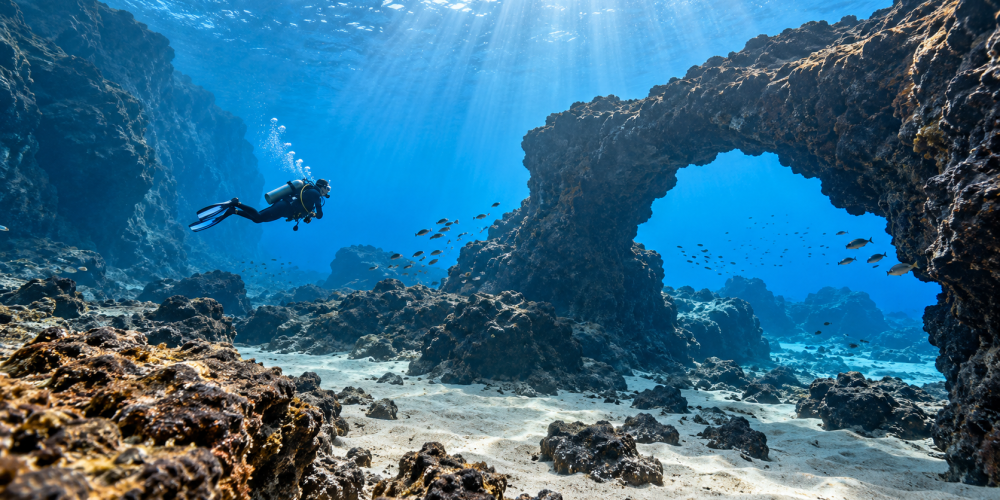
The short answer is that Yellow Mountain, known as Montaña Amarilla in Spanish, is particularly interesting because of its volcanic underwater landscape. Light-coloured sand, dark volcanic rock, rock walls, arches, small caves and canyon-like passages can all be found relatively close together. However, how challenging the dive will be depends on the chosen route, the type of entry, the depth and the conditions on the day.
Yellow Mountain is therefore not only suitable for divers who want to see as many animals as possible. The site is especially appealing to those who enjoy underwater landscapes and want to understand how clearly Tenerife’s volcanic origins can also be seen beneath the surface.
Where Is Yellow Mountain?
Yellow Mountain is located on the southern coast of Tenerife near Costa del Silencio, not far from Las Galletas. Its Spanish name, Montaña Amarilla, literally means “Yellow Mountain”. It refers to the striking yellow-orange volcanic cone directly on the coast.
The area is part of the protected Montaña Amarilla Natural Monument. According to the official conservation regulations, it is a rare volcanic cone of phreatomagmatic origin. This means it was formed through the interaction of magma and water. The protected area also includes an exposed fossil dune and areas of basaltic lava flows. The geological formation itself is the main reason why this natural monument is protected.
Even from the shore, the layers eroded by the sea are clearly visible. This impression continues underwater. The dive does not simply follow a uniform reef but leads through a landscape with distinct transitions between sandy areas and volcanic structures.
Yellow Mountain at a Glance
- Location: Costa del Silencio in the south of Tenerife, near Las Galletas
- Access: from the shore or by boat
- Seabed: sand, volcanic rock and lava formations
- Typical landscape: rock walls, arches, overhangs, small caves and canyon-like areas
- Average depth: approximately 15 metres
- Possible maximum depth: approximately 25 to 27 metres, depending on the route
- Current: often weak, but this cannot be guaranteed
- Suitable for: certified divers with different levels of experience, provided that the route and conditions match their level of training
- Special feature: strong contrasts between the light-coloured sand and dark volcanic rock
The official tourism portal of the Canary Islands gives an average depth of approximately 15 metres and a maximum depth of 25 metres for Montaña Amarilla. Ocean Trek’s dive-site description indicates a possible depth range of 8 to 27 metres. These figures do not contradict each other. Instead, they demonstrate that different routes can be followed at Yellow Mountain (Hola Islas Canarias, Ocean Trek).
What Makes the Underwater Landscape Special?
Many dive sites are described mainly in terms of the animals that may be encountered there. At Yellow Mountain, however, the landscape itself is the main attraction.
Dark volcanic rocks rise from the light-coloured sand. Between them, you will find edges, small terraces, overhangs and passages. Depending on the position of the sun, striking contrasts of light and shadow can develop. The places where a rock formation seems to rise suddenly from an open sandy area are particularly impressive.
This combination is interesting for underwater photographers because divers can be photographed effectively against the light sand or between the dark rock walls. At the same time, the surroundings require good buoyancy control. Divers who swim too close to the bottom or push themselves forwards with their fins can stir up the sand. This not only reduces visibility for the group but also disturbs animals living in or on the sand.
The arches and small caves are also visually appealing. However, they should not automatically be regarded as an invitation to enter or swim through them. The guide must decide whether a passage should be used based on its size, the swell, visibility and the group’s experience. An open arch with a clearly visible exit is different from a narrow or dark area with an overhead environment.
What Can a Dive at Yellow Mountain Be Like?
There is no single compulsory standard route. The dive site can be reached from the shore or by boat. On a shore dive, entry takes place along the coastal area. We normally enter the water from a platform with a ladder. Playa Montaña Amarilla itself consists of rocks and pebbles, making entry from the beach more difficult.
After entering the water, the route will usually begin in a shallower area. We then explore the transition towards the rock formations. Depending on air consumption, level of training and conditions, the route can remain relatively shallow or continue into deeper areas.
One possible dive combines open sandy areas with rock walls and individual passages. Another route concentrates more on the shallower structures. This ability to adapt the route is precisely what makes Yellow Mountain interesting for different divers. However, it does not mean that every route is suitable for every level of training.
When diving from a boat, there is no need to enter from the shore. However, this is not necessarily more comfortable. It depends on the swell, the current and whether the divers are prone to seasickness.
What Animals Can You See?
Moray eels and fish known in the Canary Islands as catalufas may be found in the darker areas among the rocks. Garden eels, flatfish and, with a little luck, rays, angel sharks and turtles may also be encountered on or beneath the sand. Other coastal fish species typical of Tenerife may appear between the rocks or over the sandy bottom.
It is important to have realistic expectations: Yellow Mountain is not a zoo, and the presence of any particular animal cannot be guaranteed. Angel sharks, in particular, spend a great deal of time resting on the sand and are extremely well camouflaged. Even if one is present in the area, it may remain unnoticed.
Divers who focus only on larger animals can also easily overlook smaller discoveries. It is worth looking carefully into crevices, beneath overhangs and along the transitions between rock and sand. An interesting dive often does not result from a single spectacular encounter but from the combination of the terrain, the light, the fish and careful observation.
If an animal is discovered on the sand, the group should maintain a respectful distance and avoid surrounding it. Resting or buried animals should never be touched or disturbed for a photograph.
Is Yellow Mountain an Easy Dive Site?
Montaña Amarilla is generally considered a dive site with a low to moderate level of difficulty. This depends on the weather, the type of entry and the chosen route.
A shallow route in calm sea conditions may be suitable for a certified diver with limited experience. A deeper route involving a longer swimming distance, swell or passages between the rocks will be more demanding.
The maximum depth and the number of dives in your logbook are therefore not the only deciding factors. The following points are equally important:
- your buoyancy control and finning technique
- your current level of training
- the amount of time since your last dive
- your confidence when entering the water
- your air consumption
- how comfortable you feel near rock walls and overhangs
- the actual conditions on the day of the dive
If it has been a long time since your last dive or you feel uncertain about any of these points, you should mention this openly before the dive is planned. A shallower route, a different dive site or an appropriate refresher may then be the better option.
What Equipment and Preparation Are Recommended?
In addition to your usual, fully checked diving equipment, a torch can be useful for looking into darker crevices and beneath overhangs. However, carrying a torch is not a reason to venture farther into a cave or an area without a clearly visible exit if you do not have the appropriate training.
You should also ensure that you have sufficient thermal protection. The required wetsuit thickness does not depend only on the time of year. Your personal sensitivity to cold, as well as the duration and depth of the dive, also play a role. Divers who become cold often consume more air and enjoy the dive less.
Before entering the water, we always conduct a briefing covering the following points:
- the planned route and maximum depth
- the entry and exit
- the expected current and swell
- the procedure in the event of buddy separation
- the agreed turn pressure or air reserve
- any narrow areas or passages
- how to behave around boat traffic
- an alternative plan if conditions deteriorate
Tell the dive centre about your training and diving experience as precisely as possible. Saying “I am an Open Water Diver” does not indicate whether you dive regularly, have good buoyancy control or have not been underwater for several years.
Shore Dive or Boat Dive?
Both options have advantages and disadvantages.
On a shore dive, you can reach the site directly from the coast. However, you will need to carry your equipment to the entry point and manage rocky and possibly slippery ground. A calm entry in the morning does not necessarily mean that the exit will be equally easy later.
A boat dive avoids the walk across the shoreline and can provide more direct access to certain areas. However, it also involves the usual requirements of boat diving, such as making a positive or negative entry, following the boat procedures and possibly climbing a ladder to leave the water.
The most suitable option therefore depends on more than comfort alone. It is determined by the weather and sea conditions, the planned route, the boat operation and the composition of the group. The decision should be made shortly before the dive based on the actual conditions.
Respecting the Protected Area
Montaña Amarilla is not simply a backdrop for holiday photographs but a protected natural monument. On land, visitors should use the existing paths. The sensitive geological structures should not be walked on, damaged or taken away as souvenirs.
The same basic principles apply underwater: do not touch, feed or chase animals, and do not leave any rubbish behind. Good buoyancy control protects the seabed and prevents contact with rocks or the organisms living on them. A torch should also be used carefully without shining it continuously at animals.
Precisely because Yellow Mountain appears accessible from the shore, the site should not be underestimated or treated like an ordinary beach. Independent dives require local knowledge, suitable certification, a reliable buddy and a careful assessment of the current conditions.
Who Is Yellow Mountain Suitable For?
Yellow Mountain may be particularly suitable for you if:
- you are interested in volcanic underwater landscapes
- you enjoy diving between sandy areas and rock formations
- you appreciate interesting light conditions and varied structures
- you are looking for a dive with a route that can be adapted to different depths
- you do not expect sightings of particular animals to be guaranteed
The site may be less suitable if you only want to see a wreck, expect an encounter with a particular large animal or insist on swimming through caves and arches regardless of the conditions.
Yellow Mountain may also be an option for newly certified divers, provided that a shallower route is chosen, the conditions are suitable and appropriate supervision is available. For experienced divers, the site remains interesting because of its varied structures and the possibility of following deeper routes.